Why Most Enterprise AI Projects Fail Without AI Governance
Why specialized AI governance solutions outperform general platforms in 2026. Only 12% of enterprises have mature governance. Learn the 70-30 model, compliance costs, and competitive advantage.
Look, I'll be straight with you. Most companies are deploying AI without actually knowing what they're deploying.
The numbers tell the story. Roughly 78% of organizations are using AI in at least one business function right now. But here's the kicker—only about 12% of them have what you'd call a mature AI governance structure in place. That's not a minor gap. That's a governance canyon, and enterprises are driving their AI systems across it blindfolded.
This is where the real competition is happening in 2026. It's not about who builds the fanciest model or who has the most compute. It's about who can actually govern their AI systems in a way that doesn't terrify the board, doesn't get them sued, and doesn't blow up their reputation when something goes wrong.
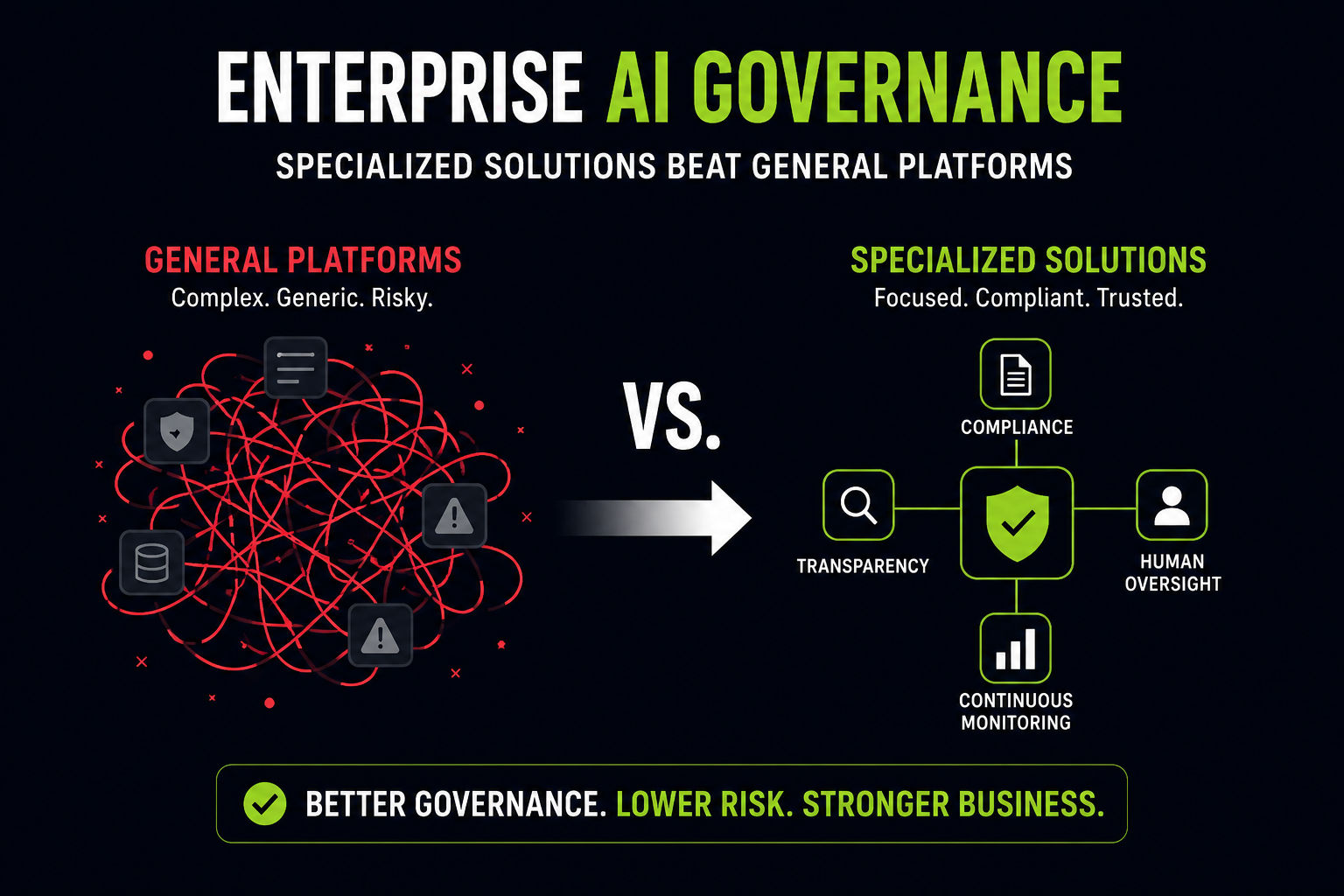
And here's what nobody wants to admit: general-purpose AI governance platforms are drowning in their own ambition.
The Governance Gap That's Costing Companies Millions
Let me paint you a picture of what's actually happening in enterprises right now.
Your CFO wants to deploy an AI system for financial forecasting. Sounds simple. Legal says "show us the documentation." Your security team says "but what about compliance?" Your data governance team says "where's that data coming from?" Your regulators (if you're in the EU) are pointing at the AI Act. And your board is asking: "What happens if this thing hallucinates our earnings?"
General AI governance platforms try to solve all of that at once. They build frameworks that try to fit healthcare AI, manufacturing AI, fintech AI, and retail AI into the same mold. The result? Massive platforms that do everything poorly instead of specific things well.
The cost to develop and deploy a single AI system ranges from $30,000 to $250,000+, depending on complexity. But compliance requirements can add an extra 10–25% on top of that. For large enterprises deploying 8–10 governance tools per AI system, those costs start multiplying in ways that make CFOs lose sleep.
What's worse is that general platforms create more work than they prevent. You're feeding data into generic frameworks, trying to map your specific risk profile to someone else's template, and spending resources on controls that don't actually matter for your use case.
Why Enterprise Governance Is Becoming the Real Competitive Moat
Here's something interesting: the market for AI governance isn't growing because governance is fun. It's growing because enterprises finally understand that ungoverned AI systems make consequential decisions.
The EU AI Act is binding now. The SEC is examining AI governance as a top priority. Financial institutions got 157 regulatory updates in a single year. And organizations? They're staring down the barrel of massive fines, reputational damage, and legal liability if things go sideways.
In 2025, nearly all large enterprises experienced financial losses linked to AI risks. We're talking $4.4 billion in compliance failures. That's not a cost of doing business—that's a wake-up call.
But here's where it gets interesting. The companies winning in this space aren't the ones who bought the biggest, most comprehensive governance platform. They're the ones who chose specialized, vertical governance solutions that actually understand their specific problems.
Think about it. An AI governance solution built for financial services understands regulatory requirements, audit trails, and explainability in a way a generic platform never will. A governance solution built for healthcare AI knows about bias detection in diagnosis support, data lineage for patient privacy, and the specific compliance frameworks that matter. A solution built for manufacturing knows about production safety, supply chain transparency, and operator override protocols.
General platforms? They know about all of it and nothing about any of it.
The 70-30 Model: Where Specialized Governance Makes Real Money
Here's a principle that actually works in practice: AI automates 70–90% of the work, humans validate the remaining 10–30%.
This looks different depending on your industry. In legal, specialized governance means AI reviews contracts, but humans sign off before submission. In healthcare, AI might flag anomalies in medical imaging, but radiologists make the call. In finance, AI processes transaction monitoring, but compliance officers approve the flags.
The key insight? This ratio only works if your governance framework understands the specific workflow you're automating.
General platforms treat this as a checkbox: "Yes, we have human-in-the-loop." But they don't actually architect your system for it. They don't know what the critical decision points are in your workflow. They don't understand where human expertise is non-negotiable versus where it's just a rubber stamp.
Specialized solutions are built for exactly this. They know where the control points are. They know what evidence matters for audit. They know how to surface the right information to the right human at the right time so the 70-30 split actually works instead of becoming a bottleneck.
And operationally? That makes a massive difference. Companies using continuous AI governance instead of point-in-time audits report 40% fewer AI-related incidents, faster deployment cycles, and better stakeholder confidence.
The Specialized vs. General Trade-off: It's Not What You Think
I get the appeal of general platforms. They promise comprehensive. They promise to handle all your frameworks at once—NIST AI RMF, ISO 42001, EU AI Act, sector-specific standards. One system to rule them all.
But here's what happens in practice. You get a system that's so broad it becomes shallow. You're filling out generic assessments for healthcare AI that don't account for clinical validation. You're mapping fintech models to frameworks that don't understand custody rules. You're sitting in endless configuration sessions trying to make a general system fit your specific constraints.
Compare that to specialist governance. You get depth. You get frameworks that actually know your industry. You get pre-built controls that match your regulatory environment. You get compliance teams who speak your language—not "AI governance" in general, but "AI governance for financial derivatives trading" or "AI governance for autonomous vehicle testing."
The trade-off is obvious: you sacrifice breadth for depth. But here's the thing—most enterprises don't need breadth. They need the parts of breadth that actually matter to them, plus surgical depth in the areas that matter most.
Real story: Financial institutions typically have 150+ regulatory updates per year. Healthcare adds another 40+ for medical-specific AI requirements. Manufacturing brings supply chain traceability concerns. These aren't the same problem wearing different hats. They're genuinely different problems.
A general governance platform treats them as variations on a theme. A specialized platform treats them as the core reality of your business.
The Board Is Asking for Proof, Not Polished Reports
Let's talk about what actually gets CFOs and board members to care about governance investments.
For years, governance was treated as compliance insurance. You did it because you had to, filed the reports, and moved on. But in 2026, boards are asking different questions.
"Show me which AI systems we have in production." Most companies can't answer this without months of detective work. General governance platforms promise to solve this with "automated AI discovery," but in practice, they find systems and then... you still have to classify them, assess them, and document them manually.
"What happened when that AI made that decision?" If your governance framework is generic, good luck finding an audit trail that actually explains the reasoning. Specialized governance builds this in from the start.
"Are we legally exposed?" General platforms give you a risk score and a heat map. Specialized governance gives you jurisdiction-by-jurisdiction analysis, regulatory mapping, and concrete remediation steps.
The companies winning this game aren't hiding behind compliance reports. They're building governance systems that actually make AI deployments faster and less risky at the same time. That's the real competitive advantage—when governance stops being overhead and starts being the infrastructure that lets you scale AI confidently.
The Real Cost of Weak Governance vs. Specialized Governance
Here's a number that should scare you: weak governance raises ongoing costs by 35% compared to structured frameworks.
That's before you factor in the financial and reputational damage of governance failures. It's just the operational cost of dealing with systems you don't fully understand.
Specialized AI governance costs money upfront—setup, configuration, team training. But the math works because you're not paying for breadth you don't need. You're paying for depth that matters. You're paying for frameworks that reduce the number of control points you have to manage, not increase them.
And there's the speed factor. Enterprises using continuous, specialized governance report faster AI deployment cycles, not slower ones. Why? Because the governance is embedded in the workflow instead of bolted on top of it. You're not waiting for quarterly audits. You're monitoring continuously, catching issues before they become incidents.
The global spend on AI governance is projected to reach $2.54 billion in 2026. That's real money. The question isn't whether to spend it—it's whether you're going to spend it wisely by choosing specialized frameworks that actually fit your use case, or waste it on general solutions that fit no one.
The Hard Truth: Governance Is How You Actually Win with AI
Here's what separates the winners from the cautionary tales.
Winners understand that AI governance isn't the thing you do after you build AI. It's the foundation you build first. It's architecture. It's how you design your systems so they can be understood, audited, and improved continuously. It's how you move from "We deployed an AI system" to "We're running an AI operation that's compliant, defensible, and actually better at its job than humans were."
Losers treat governance as a compliance checkbox. They build cool models, deploy them, and then try to retrofit governance frameworks that were never designed for their specific situation.
And the difference isn't even subtle. Organizations with mature governance frameworks experience fewer AI-related incidents, faster deployment, and better board confidence. That's not bureaucratic overhead. That's competitive advantage.
The platform you choose to govern your AI matters. A lot. But more than the platform, the question you need to answer first is: Do I need something that tries to do everything, or do I need something that does the things that matter for my business, really well?
For most enterprises in 2026, specialized governance solutions are already winning. Because the companies deploying AI fastest aren't the ones with the biggest platforms. They're the ones with governance that actually fits their reality.
Key Takeaways
- 12% of enterprises have mature AI governance, creating massive operational risk and regulatory exposure across the rest
- General governance platforms lack industry-specific depth, leading to slow deployments and missed controls
- Specialized governance solutions understand domain-specific workflows, regulatory requirements, and control points
- The 70-30 human-in-the-loop model only works when governance is designed for your specific industry and use case
- Weak governance costs 35% more than structured frameworks—not counting regulatory penalties and reputation damage
- The real competitive advantage in 2026 isn't building the smartest AI—it's governing it smarter than your competitors
Most People Asked
CS student and builder writing about tech, startups, AI, and productivity. Built a SaaS that didn't ship — walked away with real product experience instead. Sharing everything learned along the way.