Agentic AI vs Chatbots: Why $500M+ Startups Are Switching
Learn why agentic AI outperforms chatbots for startup automation. Discover the 8-week implementation path, real ROI metrics, and practical strategies your competitors are already using.
You know that moment when you realize you've been solving the wrong problem the entire time? That's where a lot of startups are right now with AI.
For the past two years, everyone's been obsessed with chatbots. ChatGPT, copilots, conversational interfaces—they're everywhere. And sure, they're impressive. But here's the thing: they're still just waiting for humans to ask them questions. They respond. That's it. They don't think ahead. They don't orchestrate workflows. They don't autonomously execute multi-step tasks while you're sleeping.
That's where agentic AI comes in. And honestly? If you're a startup trying to scale with a lean team, this is the infrastructure shift you've been waiting for.
I didn't understand the difference until I started digging into what actual companies are doing right now. The gap between "AI that answers questions" and "AI that actually does your job" is massive. And it's about to become a competitive moat that separates the winners from everyone else.
What Actually Is Agentic AI?
Let me be blunt: most of what you're hearing about AI agents is marketing noise. "Agent washing" is real—vendors are just rebranding old RPA tools and chatbots as "agents."
But true agentic AI? That's something different entirely.
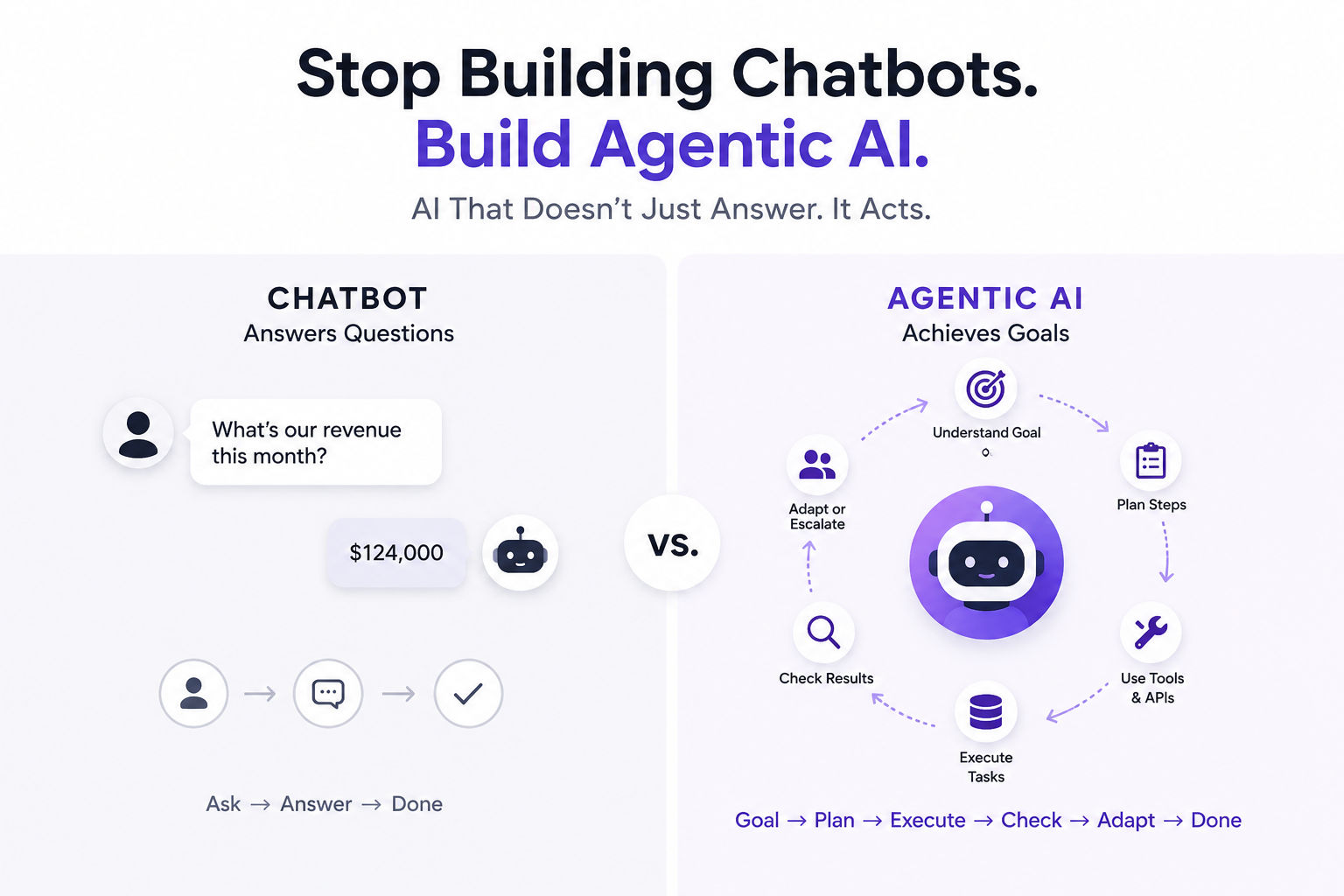
An AI agent is an autonomous system that can reason, plan, and execute multi-step workflows without human intervention at every step. It's not a chatbot waiting for input. It's more like hiring a mid-level employee who actually gets stuff done.
Here's the core difference: a chatbot responds to one query and gives you one answer. An AI agent breaks down a complex goal into smaller tasks, figures out what order to execute them in, calls the right tools and APIs, checks if the results make sense, and keeps going until the job is done. Or it escalates to a human when it hits something it can't handle.
Think about it this way:
- Chatbot: "User asks → AI responds → Done"
- AI Agent: "User sets goal → AI plans steps → AI executes → AI checks results → AI adapts or escalates → Done"
That feedback loop? That's everything. That's what makes agentic AI actually useful for real business problems.
The best part is that this isn't theoretical anymore. Right now, in 2025-2026, we're watching the shift happen in real time.
The Market Is Moving Faster Than You Think
If you're not paying attention, the numbers are pretty staggering.
By the end of 2026, 40% of enterprise applications will have task-specific AI agents integrated into them. That's up from less than 5% in 2025. We're talking about a 700%+ jump in one year.
And the revenue opportunity? McKinsey and Gartner both project that agentic AI could drive around 30% of enterprise software revenue by 2035—somewhere north of $450 billion. For context, that's up from 2% today.
For startups, the signal is clear: this is the new infrastructure layer everyone's going to need. The window to build, learn, and get ahead is open right now. Six months from now, everyone and their cousin's startup will be claiming to have "agentic" capabilities.
But here's the reality check that matters more: only 23% of organizations have actually scaled AI agents in production. Another 39% are experimenting. The rest? Stuck in pilot mode or just waiting.
That gap between hype and execution is actually your advantage as a startup. You're not trying to retrofit agents into a legacy organization. You can build for them from day one.
Why Startups Are Actually In a Better Position
I know this sounds counterintuitive, but lean startups have a massive edge here.
Enterprise companies have to retrofit agentic AI into sprawling systems, legacy databases, and teams that have been doing things the same way for fifteen years. That's... complicated.
Startups? You can architect for autonomy from the beginning. You can design your workflows assuming an AI agent is going to be running them. You can structure your data so that agents can actually use it reliably.
That's a fundamentally different starting position.
The platforms making this accessible have improved dramatically too. Most startups don't need to hire machine learning PhDs anymore. There are no-code and low-code platforms now that let product teams wire up autonomous workflows with visual builders. You can integrate 350+ apps into a multi-agent system. You can start small with a single workflow and expand from there.
I'm not saying it's trivial—it's not. But it's no longer locked behind a wall of specialized expertise and massive infrastructure budgets.
For a startup, the practical reality is this: you can pilot an agentic workflow in your highest-friction process in maybe 4-8 weeks. See if it actually saves time. See if the results are good enough. Then iterate.
That's a testing cycle you can afford. Most enterprises can't move that fast.
Where Startups Are Actually Winning Right Now
The most successful early implementations I've seen follow a pretty predictable pattern.
Start with something repetitive, rules-based, and high-friction. Document processing. Lead research and qualification. Customer support triage. Billing and invoice reconciliation. Scheduling and calendar management. Sales email sequences. These aren't sexy problems, but they're the ones that actually cost you real money every single week.
Pick one workflow. Not five. One. The one that's currently burning through the most time or causing the most errors.
Map out every step a human currently does to complete that workflow. Where do they jump between systems? Where do they have to make a judgment call? Where do they wait for information?
That's where an agent can add value.
Let's say it's your sales workflow. Right now, your SDRs spend two hours a day researching prospects, visiting websites, pulling information from LinkedIn, creating notes in your CRM, and drafting first-touch emails. An autonomous agent can do that entire workflow in seconds. Better notes. Better data. Actually linked to your CRM automatically. Waiting for your SDR to review and send.
The SDR goes from "researcher" to "reviewer and closer." That's a fundamentally different use of their time.
One startup I read about built an agent that researches target companies, enriches contact data via APIs, filters by firmographics, and drafts personalized outreach emails. The business goal was simple: increase qualified leads by 25%. The result? They hit it in Q2. And the agent improved over time as it got feedback.
That's the pattern. Find the bottleneck. Build the agent. Measure the outcome. Iterate.
The Reality Check You Need to Hear
Not everything should be agentic. And not every organization is ready for it.
Here's what's actually happening: about 40% of agentic AI projects will get canceled by 2027. Escalating costs. Unclear ROI. Bad governance. Organizations that didn't think through what they were actually trying to automate.
Most agentic initiatives right now are still experiments or proofs of concept. They're driven by hype more than actual business problems. And some of them don't even need agents—they just need better process design.
There's also the trust and safety piece. If you're an agent that can access your company's email, databases, and external APIs, things can go sideways quickly if it's not designed properly. You need guardrails. You need audit trails. You need human oversight at the right points.
The successful implementations I've seen build for safety from day one. Limited permissions. Escalation gates for high-risk decisions. Transparent logging. Regular reviews.
And data quality matters way more than people realize. An agent is only as good as the data it has access to. If your data is messy, inconsistent, or incomplete, your agent will be too.
How to Actually Start (Not in 6 Months, Not in 3 Months)
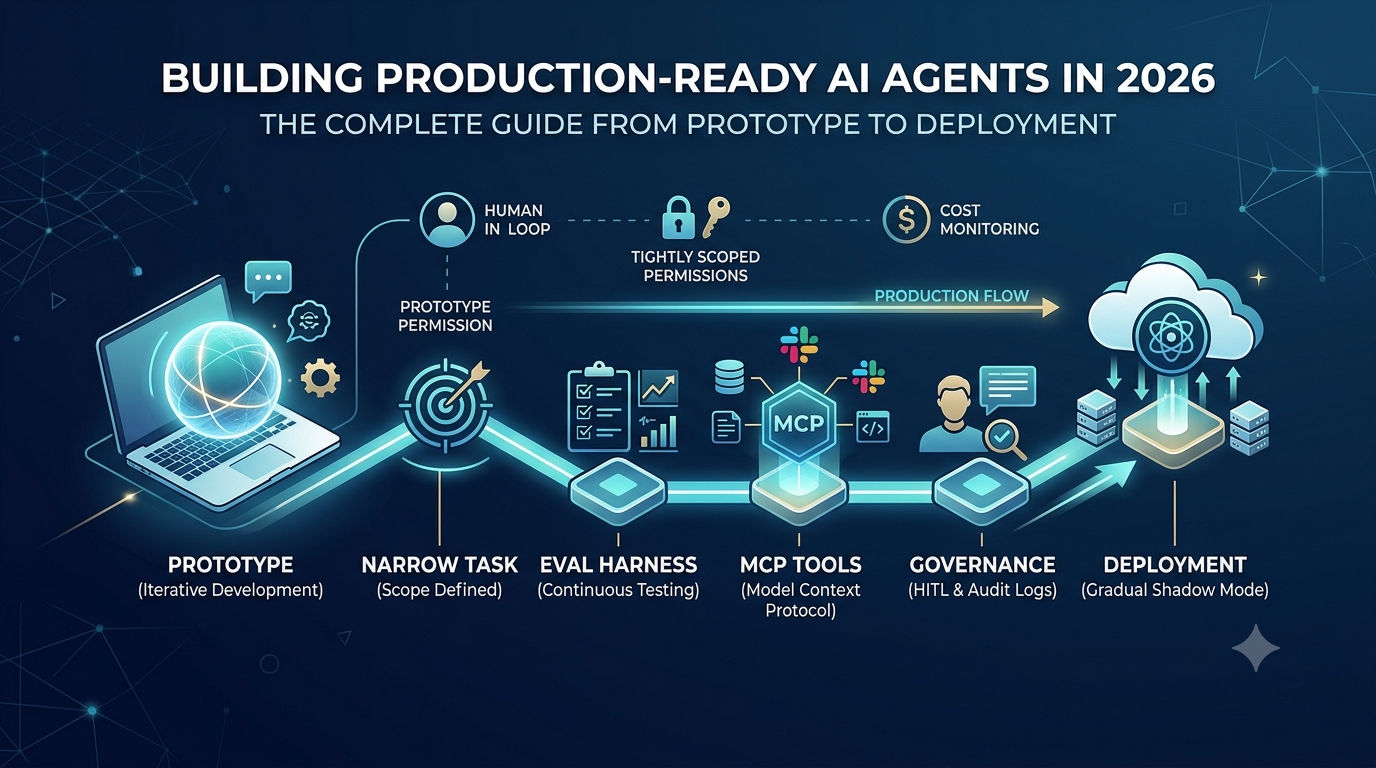
If you want to pilot this for your startup, here's the honest timeline:
Week 1-2: Pick your workflow. Map it out. Document what success looks like.
Week 3-4: Choose your platform or framework. (Most startups should start with no-code or low-code.) Get access. Run through a tutorial.
Week 5-6: Build the agent for your workflow. Integrate with the 2-3 systems it needs to talk to. Start with synthetic test data.
Week 7-8: Test with real data. Real edge cases. Real humans reviewing the output. Iterate based on feedback.
Week 9+: Deploy to a subset of users. Measure. Scale or pivot based on results.
That's doable. That's a sprint or two of work for your team.
The key is starting small and being ruthless about measuring whether it actually saves time or improves quality. If it doesn't, kill it and try something else.
No pilot purgatory. No "we'll build this massive multi-agent orchestration system eventually." Start with one problem. Solve it. Then expand.
The Companies Getting Ahead Are Already Moving
Here's what I find most interesting: the organizations treating agentic AI as just another feature or experiment are losing to the ones treating it as an operating system redesign.
Some enterprises are literally reorganizing their teams around AI agents. Merging IT and HR leadership because AI is no longer "just a tool"—it's a workforce thing. That's a structural shift.
For startups, you don't need a structural shift. You need intentional architecture decisions.
If you're building a product that manages workflows—any kind of workflows—you should be designing it assuming an AI agent might be orchestrating it. That means clean APIs. That means structured data. That means audit trails. That means thinking about how an autonomous system would interact with your product, not just a human.
The startups that lock in this mindset early are going to have capabilities their competitors can't catch up to without major refactoring.
What's Actually Going to Matter in 2026 and Beyond
The hype cycle is predictable. Right now we're in the peak of inflated expectations. Everyone's talking about AI agents. Most are struggling to make them work. Some will fail spectacularly.
By 2027-2028, the hype will cool. The companies with real, working autonomous workflows will be the ones everyone else is trying to copy.
The actual differentiation won't be "we have AI agents." It'll be "our agents are so well-integrated with our product and processes that our competitors literally can't replicate it without starting over."
That's won from day one. Not later.
The other thing that's going to matter: talent. You're going to need people who can bridge the gap between "here's a business problem" and "here's an agent-based solution." Not ML PhDs. But people who understand workflows, can reason about autonomous systems, and can think about safety and guardrails.
Those people are going to be in high demand. Get them now.
The Honest Truth About the Next 18 Months
Agentic AI is real. It's not hype. The technology works. The ROI is demonstrable.
But it's also not a magic button. You can't just slap an agent on a broken process and expect magic. You need to actually think about what you're automating and why.
The startups that nail this will have massive advantages. They'll move faster. They'll scale with smaller teams. They'll have capabilities that took traditional companies months to build in weeks.
But that only happens if you're intentional about it. Pick one problem. Build the agent. Measure relentlessly. Iterate quickly.
Stop waiting for the perfect time. Stop waiting for more frameworks or better tools. Stop waiting for everyone else to figure it out first.
The window is open right now. The technology is accessible. The business case is clear.
The question isn't "should we build agentic AI?" The question is "how fast can we start?"
Because by the time the hype cools down and everyone's paying attention, the winners will already be ahead.
Most People Asked
CS student and builder writing about tech, startups, AI, and productivity. Built a SaaS that didn't ship — walked away with real product experience instead. Sharing everything learned along the way.