Why Market Demand Matters More Than Code for Startups
Great code won't save a bad idea. Learn why market validation and problem-solution fit matter more than engineering. See real examples from Airbnb, Instagram, and Slack.
You're sitting at your laptop at 2 AM, fingers flying across the keyboard, building the most technically perfect software you can imagine. You're obsessed with clean code, elegant architecture, and flawless execution. You tell yourself: "If I build it perfectly, they will come."
But here's the hard truth nobody wants to hear—code doesn't matter nearly as much as you think it does.
I'm not saying code is unimportant. You obviously need some software to run your startup. But what I am saying is this: coding is just the vehicle. The engine that actually drives startup success? That's your idea and your market demand. And if you don't have those two things locked down, all the perfect code in the world won't save you.
Let me show you why.
The Startup Graveyard is Full of Great Code
Here's a sobering statistic: roughly 42% of startups fail because they misread market demand. Another 42% fail because they never achieve product-market fit. In both cases, the problem wasn't the code—it was the fundamental idea and whether real people actually wanted it.
Think about that for a second. We're talking about four out of five startup failures happening not because the engineering sucked, but because the founders built the wrong thing.
You can have the most beautifully engineered software ever created. You can have a codebase that would make any developer weep with joy. But if you're solving a problem nobody has, or solving it for people who don't have money to pay, or solving it in a market that's already saturated—none of that engineering perfection matters.
The code isn't the problem. The idea is.
This doesn't feel real until you see it happen in real startups. So let me show you three massive success stories where code wasn't what mattered at all.
Lesson 1: Airbnb—When the Idea Matters More Than the Platform
Let's go back to 2008. San Francisco is hosting a major design conference. Two broke designers, Brian Chesky and Joe Gebbia, are struggling to pay their rent. They notice something: there aren't enough hotel rooms for all the conference attendees.
Here's where most people would say: "I need to build an amazing, fully-featured booking platform with a sophisticated algorithm and beautiful UI."
Chesky and Gebbia did something different. They did the opposite. They built an MVP so simple it's almost embarrassing—a basic website where you could rent out an air mattress in their living room. No sophisticated matching algorithm. No advanced search filters. No mobile app. Nothing fancy.
Want to know the result? More than 600 people booked accommodations through Airbnb during that conference.
Think about what happened here. The code was terrible by modern standards. The platform was bare-bones. The UI was nothing special. But the idea—letting regular people rent out spare rooms or their entire home—solved a real problem that real people were willing to pay for.
And that's all the code needed to do. Not be perfect. Just work well enough to prove the idea had legs.
But here's the even more interesting part of the Airbnb story. After that initial success, the company faced rejection after rejection from investors. Dozens of VCs said no. The team was broke. So what did they do? Did they hire a world-class engineering team to build the ultimate booking platform?
No. They sold cereal. Literally. They created limited-edition presidential-themed cereals called "Obama O's" and "Cap'n McCains" and sold them at campaign rallies to raise $30,000. A cereal side hustle kept the startup alive long enough to eventually find investors who believed in the market demand for home-sharing.
The lesson: Airbnb didn't win because it had the best code. It won because it identified a real need and proved that need existed before scaling.
If you're still deciding what to build, read How to Choose the Best Software Startup Field: Data Analysis of 30+ Real Companies.
Lesson 2: Instagram—When Simplicity Beats Complexity
Kevin Systrom and Mike Krieger started with an app called Burbn. It was a location-based check-in app where users could check in, make plans, earn points for hanging out, and share photos.
It sounds comprehensive, right? Feature-rich. Built by smart engineers. The problem? Nobody really wanted it. Burbn was basically competing with Foursquare, a space that was already getting crowded.
But then the founders noticed something. The one feature everyone was using? Photo sharing.
So what did they do? They completely stripped away everything else. No check-ins. No location tagging. No points system. No complex social graph. Just one core idea: take a photo, apply a filter, share it with friends.
They took their code and made it simpler, not more complex.
The result? On October 6, 2010, Instagram launched on the iOS App Store. Within hours, it became the top free photography app. In one week, it had 100,000 downloads. Within two months, it had a million users. Within three years, Facebook bought it for $1 billion.
Here's Kevin Systrom talking about what he learned: "The hard part is actually finding the problem to solve. Solutions come rather easily for most problems."
He's right. The engineering to build a photo-sharing app with filters? That's not hard anymore. What is hard is identifying that there's a market of millions of people who want to share filtered photos with their friends. Once you know that market exists and that they want it, the code is almost secondary.
Instagram didn't succeed because Systrom and Krieger were the best engineers. They succeeded because they listened to what their users actually wanted and had the discipline to focus on just that one thing.
Lesson 3: Slack—The Tool Built to Solve Its Own Problem
Here's another pivot story. Stewart Butterfield and his team started a gaming company called Tiny Speck in 2009. They built an online game called Glitch. For three years, they invested millions of dollars and poured countless hours into engineering this game. It was technically ambitious. It was creative. It was built by talented developers.
It was also a complete failure in the market.
But during those three years, Butterfield's team—distributed across multiple cities—built an internal messaging tool to communicate while building the game. It was never meant to be a product. It was just infrastructure they needed to work together.
When Glitch finally shut down in 2012, something interesting happened. The team looked around at what tools they couldn't stop using, even as everything else was falling apart. That internal messaging system. It was genuinely useful. It solved a real problem.
Butterfield and his team asked themselves: Could this tool solve problems for other companies, too?
The answer was yes. They renamed it Slack (Searchable Log of All Conversation and Knowledge) and launched it publicly in August 2013. Within 24 hours, 8,000 people signed up. Within a year, they had over 500,000 daily active users. Today, Slack is used by tens of millions of people and was acquired by Salesforce for $27.7 billion.
And here's the kicker: Slack wasn't built because Butterfield hired a team of brilliant engineers and said, "Go build the best team communication platform ever." It was built because he identified a real, painful need that his own team experienced, and he built a tool to solve it.
The code was good. But the code wasn't why it succeeded. The market demand was why it succeeded.
The Pattern is Obvious—If You Look for It
Do you see the pattern here?
Airbnb: Identified unmet demand (not enough hotel rooms) → Built minimum viable product → Proved the market existed → Then scaled the code.
Instagram: Listened to what users actually wanted → Stripped away complexity → Focused on the core idea → Code became simple because the problem was clear.
Slack: Built something to solve a real internal problem → Realized the problem was bigger than just their team → Released to market → Massive adoption because demand was real.
In all three cases, the code was not the bottleneck. The problem-solving was. The market validation was. The ability to listen to what people actually wanted was.
These companies didn't win the market because they had the best engineers or the most sophisticated architecture. They won because they found ideas that solved real problems for real people who cared enough to pay.
Why Your Startup Will Probably Fail (And How to Change That)
Let's be direct: if you're a developer thinking about starting a startup, you're probably making one critical mistake.
You're thinking the bottleneck is engineering.
It's not. You can hire engineers. You can learn to code better. You can refactor. You can optimize. You can scale the infrastructure. Those problems have solutions.
But you know what you can't outsource or fix later? Finding a market that actually wants your product.
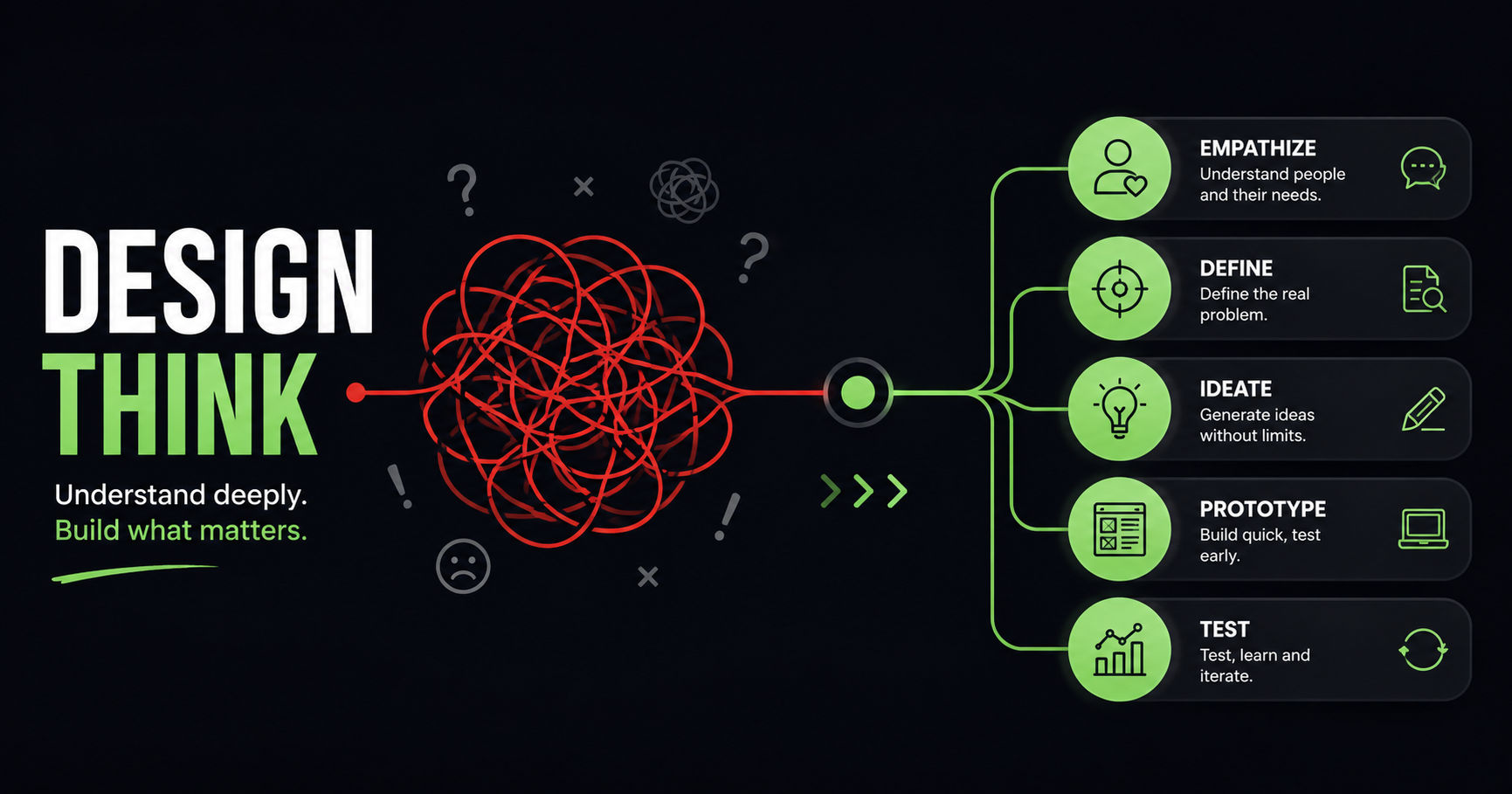
Research shows that startups that validate their market demand before building gain a massive advantage. If you're unsure how to validate ideas effectively, see Why Most Startups Build the Wrong Product (And How Design Thinking Prevents It). One study found that firms applying thorough validation procedures—like creating a minimum viable product and testing it with real customers—have a 60% higher chance of success compared to startups that skip this step.
That's not a small edge. That's the difference between likely failure and likely success.
But here's what most developers do instead: they disappear for six months, build something in secret, polish the code until it's perfect, and then launch. At that point, they've already burned months and potentially hundreds of thousands of dollars proving something that could have been validated in weeks.
The Real Priority Stack for Startups
If you're building a startup, forget about the traditional priority stack of code → design → marketing. Instead, think about it like this:
1. Problem Validation (Does the problem actually exist?) Can you describe the problem in one sentence? Have you talked to 20 people who experience this problem? Do they feel enough pain to actively search for a solution? This takes weeks, not months. You don't need code for this.
2. Market Validation (Is there actually a market?) Beyond the problem existing, is there a market of people willing to pay to solve it? How many potential customers are there? What would they pay? Can you validate this with a landing page, a demo video, or even fake door tests? Again, you don't need code. You need conversations and data.
3. Minimum Viable Code (What's the simplest version?) Only after you've proven the problem and market should you write code.
Many founders launch tiny MVPs first. See How Solo Founders Are Building $5K/Month Startups Without Developers in 2026. And when you do, make it as simple as humanly possible. Like Airbnb's air mattress website. Like Instagram's photo-sharing app stripped of everything else. Like Slack's messaging tool that solved their own problem.
4. Iteration Based on Feedback (What do users actually want?) Now you build and iterate based on real user feedback. This is where code becomes valuable. But by this point, you're not guessing. You know your market wants this. You know they'll pay. You're just making the product better.
5. Scaling the Engineering (Make it work at scale) Only once you have traction do you worry about the really sophisticated engineering problems. Caching strategies. Database optimization. Distributed systems. These are important, but they're not what determine whether your startup survives.
Most developers flip this pyramid upside down. They spend 80% of their effort on #5 (scaling and perfection) before they've even proven #1 and #2 (that the problem and market exist).
Your Competitive Advantage Isn't Your Code
Here's something that might sting a bit if you identify as an engineer: your code is not your competitive advantage.
Why? Because code is copyable. Someone smarter than you will eventually write code that's better than yours. Or they'll just hire better engineers. That's not a moat. That's not defensibility.
What is defensible? Understanding a market deeply.
If you want to understand why technically good startups still fail, read Why 90% of SaaS Startups Fail in 2026. Building trust with customers. Moving fast enough to own a space before someone else does. Having a vision that guides every product decision.
Dropbox had better file syncing than existing solutions—but file syncing isn't that hard to engineer. What was hard was understanding that regular people wanted file syncing so badly that they'd build a business around it.
Stripe didn't invent payment processing—it's been around forever. What was hard was realizing that developers hated existing payment platforms and would switch for a better API and better documentation. That's a market insight, not an engineering insight.
Superhuman didn't build a new type of email client by being better engineers. It built a product people loved by obsessing over the tiny details that actually mattered to power users. Again, market insight, not engineering insight.
Your code will be obsolete in five years. Your understanding of what your market needs? That's timeless.
The Unsexy Truth About Startup Success
Building a startup doesn't require being the best engineer. It requires:
- Talking to real potential customers (at least 20-30)
- Understanding what problem they'd pay money to solve
- Building the smallest possible version to test if they'd actually pay
- Iterating based on what you learn
None of that is technically hard. It's all socially hard. It's uncomfortable. It requires rejection. It requires admitting you were wrong about something. It requires pivoting when your initial idea doesn't resonate.
But it's infinitely more important than writing perfect code.
What This Means for You
If you're a developer wanting to start a startup:
-
Stop optimizing for code quality first. Optimize for learning first. Your goal is to validate that a market exists for your idea, not to ship perfect software.
-
Talk to potential customers before you code. Spend two weeks understanding the problem before you spend two months building a solution. The customer conversations will teach you more than any amount of coding will.
-
Build the smallest possible version. When you do code, make it intentionally simple. Force yourself to cut features. Make it a game to see how simple you can make it while still proving the core idea.
-
Iterate based on real feedback, not your assumptions. You will be wrong about what people want. Instagram started as Burbn. Slack started as a game. Airbnb was supposed to be a short-term rental platform and became something more. Your initial idea will evolve. That's not failure. That's learning.
-
Remember that code is a tool, not the product. The product is the solution to the customer's problem. The code just delivers it. Focus on the problem and the customer. The code will follow.
If you're building an AI startup, you may also like Chatbots Are Dead. This Is What $500M+ Startups Are Doing Now.
The Bottom Line
Your startup won't succeed because you're the best engineer. It won't succeed because you write elegant code or have a sophisticated architecture or optimize your databases perfectly.
It will succeed because you identify a problem that real people care enough about to pay you to solve it. And you're willing to validate that market need before you commit six months and six figures to building something nobody wants.
Code is just a tool. It's how you deliver the solution. But the solution itself—the idea and the market validation—that's what matters. That's what actually moves the needle.
So before you write another line of code, ask yourself: Have I actually talked to potential customers? Do they experience this problem? Would they pay to solve it?
Answer those questions first. Then write the code. Not the other way around.
That's how you build startups that actually succeed.
Most People Asked
CS student and builder writing about tech, startups, AI, and productivity. Built a SaaS that didn't ship — walked away with real product experience instead. Sharing everything learned along the way.