Design Thinking for Startups: Build Products People Want
Learn design thinking to validate customer needs before building. Master prototyping and discover why most startups build the wrong product—and how to avoid it.
Look, I've watched a lot of startups fail. Not because they had bad ideas. Not because the founders weren't smart or hardworking. They failed because they built something nobody actually wanted.
It's a brutal reality check. You spend months building the "perfect" product. You're excited. You launch it. And... crickets.
That's where design thinking comes in. It's not magic, but it's pretty close.
Here's the thing: design thinking for startups isn't some fancy framework invented by Silicon Valley gurus. It's actually a practical, methodical way to understand what your customers really need—before you waste time and money building the wrong thing.
I'm going to walk you through how to use design thinking to validate your startup idea, talk to real customers, build prototypes that actually teach you something, and iterate your way toward a product people can't live without.
What Is Design Thinking Anyway?
Design thinking is basically a problem-solving approach that puts people first. Instead of asking "What can we build?" it asks "What do people actually need?"
That simple shift changes everything.
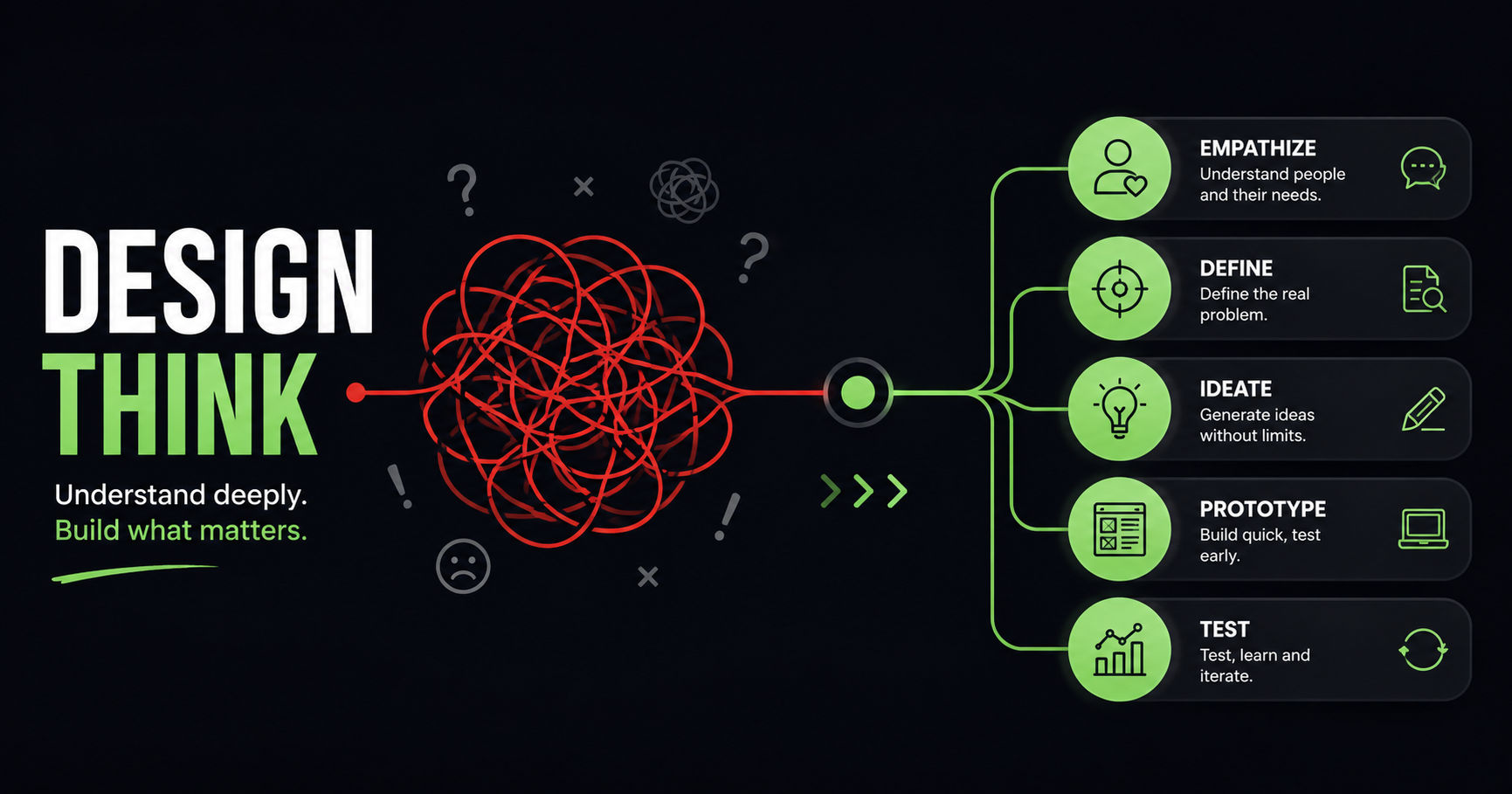
The Stanford d.school—the design school at Stanford University—popularized this framework. They break it down into five stages: empathize, define, ideate, prototype, and test. But here's the key thing to understand: it's not linear. You're going to loop through these stages over and over. That's not a bug; it's the whole point.
IDEO, the legendary design firm, has a slightly different take. They talk about Discovery, Interpretation, Ideation, Experimentation, and Evolution. Same idea, different words. The common thread? Obsess over your customer first. Everything else comes second.
Why does this matter for startups? Because you don't have the budget to guess wrong. You've got limited runway, limited resources, and limited patience from investors. Design thinking helps you eliminate waste by validating assumptions early and often.
The First Stage: Empathize (aka Actually Talk to People)
This is where most founders get it wrong. They think they already understand their customer. After all, they ARE the customer, right?
Wrong. Or at least, not always.
Empathize means you genuinely listen to your target audience. You do customer research. You conduct interviews. You observe how people actually use products like yours. You stop talking and start listening.
Customer research for startups doesn't have to be complicated. You don't need a fancy research firm or a six-month study. You need conversations.
Real, messy, unscripted conversations.
I like to think of user research as detective work. You're looking for patterns. What's the problem keeping them awake at night? What solutions have they already tried? What didn't work? Why?
Here's a simple framework: conduct 10-15 customer interviews. Aim for people who actually match your target audience. Ask open-ended questions. Listen more than you talk. Let them ramble a bit—that's where the gold is. When someone says "That would never work for me because..." you've just found a goldmine of insight.
Then do some surveys if you want numbers. But don't stop there. Numbers without stories are just noise.
Defining Your Customer's Real Problem
After you've talked to enough people, you're going to notice patterns. Certain pain points keep coming up. Certain jobs people are trying to accomplish. Certain frustrations that appear over and over.
This is the Define stage. And it's critical. Because if you define the problem wrong, you'll solve the wrong problem brilliantly.
You've probably heard the phrase "the design process" thrown around a lot. What we're doing here is designing the solution to the actual problem, not the problem you thought existed when you woke up this morning.
A good problem definition looks something like this: "Busy parents struggle to [specific pain point] because [root cause], and they currently try to solve it by [current solution], but [why that doesn't work]."
Specific. Real. Grounded in what you learned from actual conversations.
This is where empathy mapping helps. An empathy map is a tool—basically a four-quadrant chart where you fill in what your customer says, thinks, does, and feels. It forces you to think beyond surface-level demographics. It's not "Sarah, age 35, marketing manager." It's "Sarah is frustrated because nobody listens to her ideas in meetings, so she's learned to keep quiet, but inside she's angry, and she thinks maybe it's her fault."
That's real empathy. That's what design thinking is actually about.
Ideate Like You've Got Nothing to Lose (Because You Don't)
Once you've nailed the problem definition, it's time to brainstorm solutions.
Ideate means you generate a bunch of ideas. A LOT of ideas. Crazy ideas. Ideas that might not work. Ideas that seem dumb at first. That's the whole point.
During ideation, you're not judging ideas. You're quantity over quality. You're trying to surface every possible approach to solving the problem your customer actually has.
Here's what typically happens: you have your "best" idea, and it's probably not actually the best. It's just the first one that came to mind, or the one you got attached to emotionally. Ideation helps you see past that.
Generate 20 ideas. 50, even. Write them down. Sketch them out. Talk through them. Some will be genuinely creative breakthroughs. Most won't. But those breakthroughs won't happen unless you push past the obvious.
Prototyping: Building Fast, Learning Faster
Now here's where it gets real. You're going to build something. Not the full product. Not even close.
A prototype is a rough, quick version of your idea. It might be a sketch. It might be a landing page. It might be a video mockup. It might be literally just using Figma to show what the experience would feel like.
The goal is to test your core assumption with the least amount of work possible.
Most founders overthink this. They think "prototype" means building a working MVP development version. Nope. You're trying to learn fast, not impress anyone.
I watched one founder describe his product idea to 50 potential customers using just a simple mockup on his phone. No code. No polish. Just "Here's what I'm thinking—does this solve your problem?" He learned more in two weeks than most founders learn in three months of development.
An MVP development approach is slightly different from a prototype, by the way. An MVP (minimum viable product) is an actual, functional version of your product. It's the smallest thing you could build that actual customers would pay for or use. It's designed to validate that there's genuine market demand, not just interest.
The prototyping stage is where you test hypotheses about your solution. The MVP stage is where you test whether people will actually use your solution.
User Testing: Let Real People Break Your Ideas
You've built a prototype. You're proud of it. You think it's elegant. You think it solves the problem perfectly.
User testing is where reality smacks you upside the head.
User testing means putting your prototype in front of actual potential customers and watching what they do. And this is important: you watch. You don't explain how to use it. You don't narrate. You just let them try to figure it out.
If they're confused, that's gold. That's a learning. If they can't find the core feature without help, you need to redesign. If they ignore your favorite feature and use something else instead, well, now you know what actually matters.
Run user testing sessions with maybe 5-10 people. That's usually enough to surface the major usability issues. You'll see patterns. You'll hear "Wait, how do I..." or "Oh, I thought it would..." or "That's confusing."
And you know what? That's success. Because you're learning what doesn't work before you've spent six months building it.
The Lean Startup Connection: Iterate or Die
All of this ties back to something called the lean startup methodology. The basic idea: you build something small, you measure whether it works, you learn from the results, and you iterate.
Build. Measure. Learn. Repeat.
This is the rhythm of design thinking applied to startups. It's not "build a perfect product and then launch." It's "build something testable, gather feedback, make decisions, and move forward."
The lean startup approach was popularized by Eric Ries, who emphasized something that sounds obvious but most founders ignore: you don't know what customers will do until you actually watch them do it. Surveys, focus groups, wishful thinking—none of that matters compared to what people actually do with your product.
Real-World Example: How It Actually Works
Let's say you're building a scheduling app for freelancers.
You start with empathize. You talk to 15 freelancers. You learn that their biggest pain is switching between three different calendars, constantly double-booking themselves, and wasting time on logistics instead of actual work.
You define the problem: "Freelancers spend 30 minutes a day managing scattered calendars and lose money to missed bookings because they can't see their availability at a glance."
You ideate. You come up with 30 ideas ranging from "unified calendar dashboard" to "AI that auto-negotiates your schedule" to "let clients book directly from your website."
You prototype the dashboard idea. You sketch it out. You get feedback from five freelancers. Four of them say it doesn't integrate with their existing tools, so it's useless. One of them mentions that the real problem isn't seeing availability—it's actually turning away bad-fit clients without feeling guilty.
Whoa. That's a different problem entirely.
So you iterate. You go back and talk to more freelancers about this bad-fit problem. You learn that most of them say yes to work they shouldn't because they feel obligated or they're not confident in their ability to say no.
You prototype a different solution: a simple form that helps them define their boundaries and shows them a script for saying no.
You test it. Freelancers use it. Some actually use it to turn away work. Some love it. Some don't care.
You've now got something real to build on.
Making This Work When You're Bootstrapped
Okay, I get it. You don't have time for all this. You've got a job. You're bootstrapping. You need to move fast.
Here's the real secret: design thinking actually saves you time once you get the hang of it.
Quick customer research beats months of development. A 10-minute prototype beats a polished mock-up. Real user feedback beats your intuition.
Start small. Talk to five potential customers this week. Ask them about their problem. Don't pitch. Just listen.
Next week, sketch something on a whiteboard and show it to them. Five minutes. Does it address their problem? Would they use it?
The week after, build a really simple version using no-code tools if possible. Or just fake it—fake a working version using a combination of Google Sheets and email automation if that's all you can manage.
Put it in front of people. Watch what happens.
That's the design thinking process. It doesn't require Stanford credentials or VC funding. It requires curiosity and the willingness to learn that your first idea probably isn't your best idea.
The Design Process Isn't About Being a Designer
Here's the thing I want to hammer home: you don't need to be a designer to use design thinking. You need to be someone who genuinely cares about solving a real problem for real people.
The design thinking methodology is a tool. The design process is a way of thinking. It's about:
- Obsessing over your customer's actual needs (not your idea of their needs)
- Testing your assumptions before you build
- Iterating based on real feedback, not opinions
- Building only what matters
- Staying humble when you're wrong
This is how actual successful products get built. Not by a lone genius thinking up a perfect idea in the shower. By teams that talk to customers, iterate constantly, and build what people actually want.
The Five Stages One More Time (Now You Get Them)
Let's just recap because understanding the actual flow matters.
First: empathize. Get to know your customer. Do customer research. Conduct interviews. Observe. Listen.
Second: define. Take everything you learned and summarize the actual problem. Not the problem you thought existed. The real one.
Third: ideate. Generate tons of ideas. Brainstorm. Don't edit yourself.
Fourth: prototype. Build the simplest possible version to test your core assumption.
Fifth: test. Put it in front of real people. Run user testing. Gather feedback.
Then you start over. You've learned something. That learning changes your next round of development. You go back to empathize stage if you need to reframe the problem. Or you iterate on your prototype. Or you pivot entirely because you learned your initial assumption was wrong.
That's not failure. That's design thinking working exactly as intended.
Start Today
You don't need permission to start doing this. You don't need a course. You don't need a fancy template.
Identify five people who might use your product. Email them. Ask for a 15-minute call. Talk about their problems. Listen.
That's design thinking. That's the start of everything.
The companies that win aren't the ones with the perfect product at launch. They're the ones that stay obsessively focused on what their customers actually need, and they iterate relentlessly based on reality instead of ego.
Do that, and you've got a shot.
Most People Asked
CS student and builder writing about tech, startups, AI, and productivity. Built a SaaS that didn't ship — walked away with real product experience instead. Sharing everything learned along the way.