Open-source Zapier alternatives: n8n, Activepieces & Huginn
Compare open-source Zapier alternatives with pricing, features, and setup complexity. Make the right choice for your workflow automation needs.
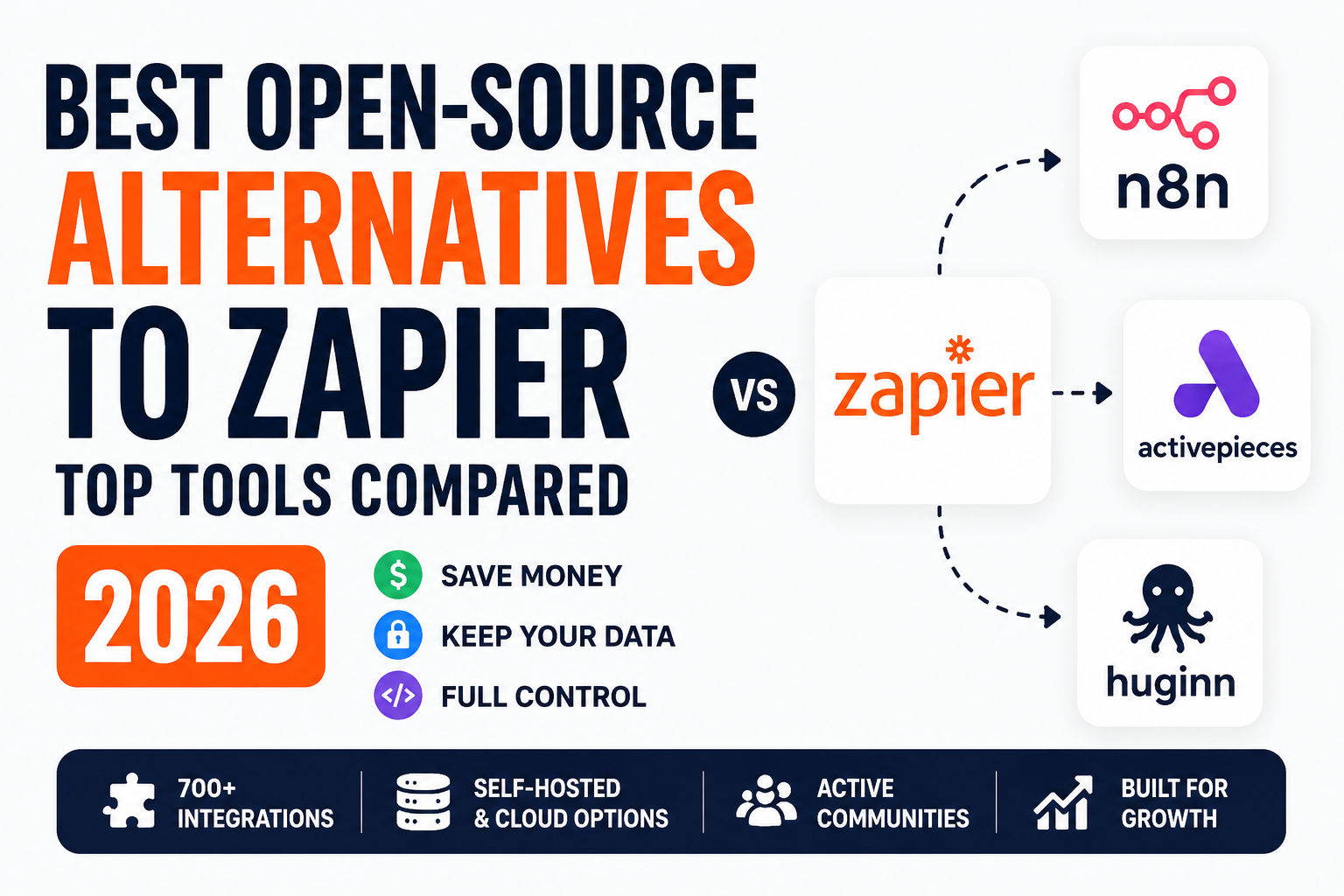
Best Open-Source Alternatives to Zapier: Top Tools Compared 2026
If your Zapier bill just crossed into the hundreds and you're wondering if there's another way, you're not alone. The answer is yes—and it costs way less than you think.
The short version: Open-source automation platforms like n8n, Activepieces, and Huginn let you take control of your workflow automation without paying per-task fees. You get the same workflow automation you love from Zapier, but self-hosted on your own infrastructure and licensed under permissive open-source terms. No vendor lock-in. No surprise price bumps when your usage grows.
This guide compares the actual best open-source Zapier alternatives in 2026, with real pricing, integration counts, and honest tradeoffs. By the end, you'll know exactly which one fits your team.
Why People Actually Switch from Zapier
Cost is the obvious reason. Zapier's task-based pricing model scales linearly with volume. A workflow that ran 1,000 times a month used to feel free. At 100,000 times a month, it's expensive. That's when open-source alternatives start looking smart.
But cost isn't the whole story.
Vendor lock-in bites harder the longer you stay. You build workflows that only Zapier can run. You depend on Zapier's integration library. If they discontinue an app connector you rely on, you're stuck. Open-source tools let you fork, modify, and maintain your own integrations if you need to.
Data residency matters more every year. If you're in Europe, Australia, or anywhere with strict data-residency laws, sending all your workflow data through Zapier's US-hosted infrastructure can be legally problematic. Self-hosted open-source automation keeps your data on your servers, under your compliance rules.
Finally, there's the control factor. On Zapier, you're constrained by what the product team decides to build. With open-source alternatives, you can customize the codebase, add features, and extend functionality exactly the way your team needs it.
A Quick Look at Zapier's Limitations
Zapier is genuinely good at what it does. Its free plan is now capped at 100 tasks per month with two-step limits. That's barely enough to test if two apps connect. Paid plans start at roughly $30/month and climb quickly as you add workflows and volume.
The bigger friction point: Zapier's UI is linear. Complex branching logic, multi-step conditionals, and loop-heavy workflows feel clunky. Non-technical teams can use it, but once you need sophisticated automation, you hit a ceiling.
And the integrations, while massive (Zapier claims 8,000+), don't cover every tool. If you use a niche SaaS platform or an internal API, you'll be writing webhook workarounds.
The Open-Source Alternative Framework
When evaluating workflow automation tools, five things matter most:
1. Integration breadth
How many apps can you connect out of the box? Does it have HTTP/REST fallback for custom APIs?
2. Pricing model
Per-task (like Zapier)? Per-month flat rate? Free if self-hosted? What does infrastructure cost?
3. Ease of use
Visual builder or code-first? Can non-technical teammates use it, or is it developer-only?
4. Self-hosting support
Can you run it on your own servers? What's the complexity—Docker, Kubernetes, or full setup?
5. Community maturity
How big is the community? Can you find help at 11pm when something breaks? Are there templates and tutorials?
The best choice depends on which of these matters most to your team.
n8n: The Mature Powerhouse
What it is: n8n is the largest open-source workflow automation community (190,000+ GitHub stars). It's been around since 2019, battle-tested at scale, and backed by serious funding (SAP investment in 2026 roughly doubled its valuation).
Pricing:
- Self-hosted: Free (open-source, fair-code license)
- Cloud: €20/month (€240/year) for 2,500 executions
- Pro plan: €50/month for 10,000 executions
- Infrastructure cost (if self-hosted): ~$10-20/month for a decent VPS
Integrations:
400+ official nodes, plus 1,000+ community-contributed integrations. If something's not there, the HTTP Request node lets you connect to any REST API directly.
What makes it strong:
You get a visual canvas where each step is a "node." The node library is massive. You can write JavaScript or Python inside workflow steps. There's built-in support for Git versioning, environment variables, and secrets management—features that feel like a Zapier pro plan but are free.
n8n also has native AI capabilities. Vector stores, LangChain primitives, structured output parsing, and tool-calling agents are all first-class features. If you're building AI workflows, n8n gets it.
The tradeoff:
The learning curve is real. The visual canvas is more technical than Zapier's linear flow. Non-technical teammates will stumble at first. The node-based approach has more mental overhead than simpler tools.
The community has complaints about n8n's licensing too. It's not fully open-source (it's fair-code). If you want to embed n8n into a product you sell, you need a paid commercial license.
Best for: Developers, technical operations teams, enterprises building AI agents, teams that outgrew Zapier's UI.
Activepieces: The Fast-Ramp Alternative
What it is: MIT-licensed, no-code-first automation platform built by ex-Firebase engineers. Backed by Y Combinator. Launched in 2023, but growing aggressively (22,000+ GitHub stars).
Pricing:
- Self-hosted: Free (MIT license, no restrictions)
- Cloud: $16/month (free tier: 1,000 tasks)
- Infrastructure cost (if self-hosted): ~$10-20/month
Integrations:
747+ integrations (as of June 2026), growing weekly. Slightly fewer than n8n, but coverage is strong for common SaaS tools.
What makes it strong:
Activepieces was designed with "get results fast" as the philosophy. The step-based vertical builder is cleaner than n8n's canvas. Non-technical team members can ship their first workflow in 10 minutes, not hours.
It's fully MIT-licensed, which means zero commercial strings. Embed it in your product, fork it, modify it—no licensing fees. This matters if you're a SaaS company building automation into your own platform.
Activepieces also ships with native Model Context Protocol (MCP) support. That means you can expose your flows as tools to external AI systems (Claude, ChatGPT, etc.) and use MCP servers inside Activepieces. The AI integration feels modern and purposeful.
The tradeoff:
For complex workflows, Activepieces' linear step builder starts to feel limiting. If you need advanced branching, parallel loops, or sophisticated data transformations, you'll hit the ceiling faster than you would with n8n.
The integration library is smaller. You'll occasionally find that n8n has a connector Activepieces doesn't, forcing you into HTTP workarounds.
Best for: Small teams, founders, non-technical users, SaaS companies embedding automation, teams that need MIT licensing.
Huginn: Maximum Privacy, Maximum Friction
What it is: The old guard. Written in Ruby. Described as "a self-hosted, hackable version of IFTTT or Zapier." Been around longer than most. MIT license. No commercial backing.
Pricing:
- Self-hosted only: Free (MIT license)
- Infrastructure cost: ~$10-20/month (Ruby on Rails app, moderate resource use)
Integrations:
Limited and growing slowly. Heavy focus on web scraping, RSS feeds, webhooks, email. Less focus on SaaS connectors.
What makes it strong:
Huginn is as close to total data privacy as you can get. Everything runs on your server. No cloud component. No vendor lock-in at all—you own the entire thing. If GDPR compliance or absolute data residency is non-negotiable, Huginn is the answer.
It excels at web scraping, event monitoring, and complex agent-based logic. You can build sophisticated automation by chaining "agents" together. Each agent handles one task, and events flow between them.
The tradeoff:
Huginn's configuration model is JSON-heavy, not visual. You're essentially writing configuration files rather than clicking a builder. The UI is minimal and feels dated. There's no visual canvas at all—you see a list of agents and their connections.
Setup and scaling require Ruby expertise. If your team doesn't know Rails, maintaining a Huginn instance becomes a burden.
The agent-based mental model is also harder to reason about than visual workflows. Debugging is slower. Documentation is lighter than n8n or Activepieces.
This isn't a tool for teams that need quick wins. It's a tool for developers who value radical privacy and control above everything else.
Best for: Privacy-obsessed organizations, developers comfortable with Ruby, use cases heavy in web scraping and event monitoring, teams with strict data residency rules.
Make (Formerly Integromat): The Affordable Hosted Hybrid
Make isn't open-source, but it's worth mentioning because it solves the core problem—cost—without requiring self-hosting.
Pricing:
- Core plan: $9-16/month (9,000-10,000 operations)
- Pro: $29-50/month (50,000+ operations)
At scale, Make is 3-5x cheaper than Zapier. A workflow that costs $200/month on Zapier might cost $50/month on Make.
What makes it strong:
Visual workflow builder. 3,000+ integrations. Supports complex branching and data transformations. Built-in AI agents (as of 2026).
The tradeoff:
Not open-source. Data stays in Make's cloud (EU or US data centers, depending on plan). You're trading pricing for control—opposite of the open-source tradeoff.
Best for: Teams that want affordability without managing servers, non-technical users, SMBs.
Pabbly Connect: The Flat-Rate Outlier
Flat-rate pricing. No per-task metering. You pay once, run as many workflows as you want.
Pricing:
- Monthly: $99/month (unlimited workflows, unlimited tasks)
- Lifetime: $490 (one-time, lifetime access)
The lifetime plan is mathematically unbeatable if you're in this for the long haul.
What makes it strong:
Simplicity. No overage charges. 500+ integrations cover most common use cases.
The tradeoff:
Not open-source. Hosted-only. Less powerful than n8n or Activepieces for complex logic. Smaller community.
Best for: Freelancers, agencies, teams running many simple workflows, budget-conscious founders.
Pipedream: The Code-First Path
Pipedream is developer-first. You write JavaScript or Python directly inside workflows. It's event-driven (webhooks trigger automations instantly).
Pricing:
- Free plan: 100 credits/month
- Paid plans: $29-99/month
Integrations:
Not traditional "integrations"—you write code and call APIs directly. Flexibility over pre-built connectors.
What makes it strong:
Complete control. No UI constraints. You can build anything. Excellent for developers who'd rather code than click.
The tradeoff:
Hosted-only (no self-hosting). Not open-source. Requires JavaScript/Python skills. Not suitable for non-technical teams.
Best for: Developers, custom API integrations, event-driven workflows, teams comfortable with code.
Comparison Table
| Feature | n8n | Activepieces | Huginn | Make | Pabbly | Zapier |
|---|---|---|---|---|---|---|
| License | Fair-code | MIT | MIT | Proprietary | Proprietary | Proprietary |
| Self-hosting | ✅ | ✅ | ✅ | ❌ | ❌ | ❌ |
| Price (self-hosted) | Free | Free | Free | - | - | - |
| Integrations | 400+ | 700+ | Limited | 3000+ | 500+ | 8000+ |
| Ease of use | Medium | Easy | Hard | Easy | Easy | Very easy |
| AI capabilities | ⭐⭐⭐ | ⭐⭐ | ⭐ | ⭐⭐⭐ | ⭐ | ⭐⭐ |
| Community size | Large | Growing | Stagnant | Large | Medium | Very large |
| Best for | Devs, scale | Teams, founders | Privacy | Budget | Flat-rate | General |
Making the Choice: A Simple Framework
Ask yourself three questions:
1. Is self-hosting a must?
If yes → n8n, Activepieces, or Huginn.
If no → Make or Pabbly (cheaper, hosted for you).
2. Who's using this? Developers or non-technical teammates?
Developers → n8n or Pipedream (code-first).
Non-technical → Activepieces or Make (visual builder).
Privacy-obsessed → Huginn (sacrifice ease for control).
3. How much volume are we automating?
Light (< 10,000 tasks/month) → Activepieces cloud ($16/mo) or Pabbly ($99/mo flat).
Heavy (100,000+ tasks/month) → Self-hosted n8n or Activepieces (~$20/mo infrastructure, free software).
Massive (1M+ tasks/month) → n8n self-hosted with a proper database and scaling setup.
The Setup Reality Check
Self-hosting means maintenance. Even with Docker, you need to:
- Manage a VPS or Kubernetes cluster
- Keep the application updated
- Back up your workflows and data
- Monitor uptime and logs
- Handle security patches
For a small team without DevOps expertise, managed alternatives (Make, Pabbly, or Activepieces cloud) might save more money than you save on licensing.
For enterprises or teams with DevOps capacity, the self-hosted model pays for itself within a few months.
Why Your Team Might Still Use Zapier
Be honest with yourself: Zapier's massive integration library is its real moat. If you use a thousand different SaaS tools, there's a chance Zapier has a pre-built connector and the alternatives don't.
Zapier also has the largest community. More templates. More tutorials. More help when you get stuck.
If your workflows are simple, your team is non-technical, and you're automating less than 10,000 tasks per month, Zapier's ease of use might outweigh the cost.
But if you're past 50,000 tasks per month, or you need self-hosting for compliance, or you want to avoid vendor lock-in, the open-source alternatives are genuinely better now. The gap closed in 2025-2026.
The Real Decision
Pick n8n if you need power, scale, and AI capabilities. Your team has developers. You plan to self-host or use their managed cloud.
Pick Activepieces if you want the easiest path to self-hosting. Non-technical teammates can contribute. MIT licensing matters to you.
Pick Make or Pabbly if self-hosting sounds like a headache. You want hosted simplicity at a fraction of Zapier's cost.
Pick Huginn only if data privacy is your religion and you have Ruby expertise in-house.
Any of these beats Zapier once you understand the tradeoff: you trade ease of discovery for control and cost. The days of "Zapier is the obvious choice for workflow automation" are over.
The best open-source alternative to Zapier is the one your team will actually use. Test a few. Run a real workflow. Feel the difference. Then decide.
CS student and builder writing about tech, startups, AI, and productivity. Built a SaaS that didn't ship — walked away with real product experience instead. Sharing everything learned along the way.